The Ford GT. I’ll drive this car any day. (Photo: Rafe Needleman/Yahoo)
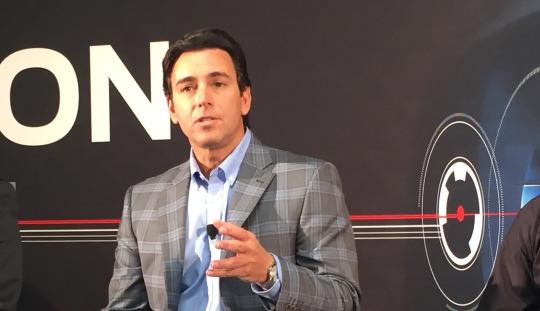
Mark Fields, the new CEO of Ford, paid a visit the the nerd journalist corps last week. He visited Ford’s Research and Innovation Center in Palo Alto, California. While his people were showing off the new Ford GT (quick review: holy wow) and weird plastic springs the company will be using soon to save weight in its cars, I got a chance to spend a few minutes with him one-on-one.
From my perspective, one interesting threat to the status quo of car companies is autonomous vehicles. Self-driving technologies could re-write the car business.
Fields, of course, says he sees new technology as an opportunity.
For people who want self-driving cars, Ford will eventually offer them. For those that like to drive, that’ll stay an option. “We will offer a full line of autonomy levels,” he told me. He emphasized that, at least in our lifetimes, Ford cars will always offer their owners the capability to drive. If they want it.
Ford CEO Mark Fields at the Ford Research and Innovation Center in Palo Alto, CA. (Photo: Rafe Needleman/Yahoo Tech)
“We don’t see a disconnect,” he said. “We don’t see driving and autonomy as exclusive.” He said Ford will continue to work on making cars that are “both fun to drive and fun to ride,” and that “there will always be a spectrum of autonomy, in our lifetime.” (To calibrate that statement: Fields is 54.)
However, during an earlier presentation at the Research Center that day, Ford execs discussed the challenges of building cars that are safe to drive in spite of the advancements in self-driving technology. The problem isn’t just that technology can distract drivers from operating their cars safely. There’s also the reverse problem: If cars are too autonomous and thus too boring to pay attention to while they are driving, the human “driver” might not be paying attention when he or she needs to take over.
For this reason, Google has proposed taken the driver out of the loop completely its prototype self-driving pod cars. There’s a big red emergency stop button, but no steering wheel or pedals. There’s no way the driver/passenger can make a bad decision and screw things up, and the car’s programmers don’t have to account for unpredictable humans trying to take control.
Fields also sees electric propulsion gathering steam, as it were. While he wouldn’t predict when (or if) electric cars will become mainstream, he did say that Ford will continue to offer more options. “Our approach is to offer choice,” he said.
The Uberization
Another fundamental threat to the future of the car business is the changing nature of car ownership. Fields sees this. “A certain population wants access more than ownership,” he said. And Ford, ultimately, is not a car company per se. “We’re a mobility company.“
Ford is running 25 experiments around the globe, he said, working on things like “usership” instead of ownership, and using social collaboration tools to help people find cars to get them where they are going. “We are trying to solve big societal issues,” he said.
(One cool technology Ford is working on, that sounds like a Silicon Valley fantasy: The ability for cars to recognize open parking spaces they pass by, and then transmit this data to a service that tells other cars, whose drivers are looking for spots, where one is near them.)
Too much tech?
My big fear, when it comes to automotive technology, especially from a company that’s newly trying to re-cast itself as a service company, is that its services will know a bit too much about their customers: Where they are, who they may be with, and what they are doing in their mobility devices.
Fields didn’t quite have an answer for this, but he did have a line at the ready. “We are committed to being trusted stewards of customer data,” he told me. “We have to ask the customer whether they want to opt it.”
He told me the customer has to see a benefit of sharing data. For example, a car that knows it needs an oil change could help its owner schedule the service.
But what about insurance companies who give you better rates when you opt in? Won’t they eventually make keeping your driving data private unaffordable? Or over-eager courts, or police, who absorb data under arguably legal, but questionable pretense?
Just as it is for online companies and mobile phone companies, stewarding customer data is tricky. Especially when customers seem to be so eager to expose so much data in return for, usually, incremental value.
Call it usership or ownership or whatever you like, but technology is changing our relationship with nearly every facet of mobility. Ford may indeed remain a “Big 3″ auto maker for the foreseeable future. But it’s also possible that technology will drive new companies to prominence, just as it has for nearly every other industry on the planet.
Did you hear the one about how Apple Watch apps from third-party developers aren’t allowed to tell the time?
No, really. It’s an actual rule from Apple listed under section 10 of the company’s “App Store Review Guidelines”. It reads: “Watch Apps whose primary function is telling time will be rejected.”
The Apple Watch represents an unprecedented leap forward by Apple in many ways, but the workings of its app store isn’t one of them. As it’s done with the iPhone and the iPad, Apple has specific ideas about what third-party apps can and cannot do.
Color Inside the Lines
Apple’s guidelines outlining its App Store rules, in which the phrase “will be rejected” appears 103 times, should make one thing clear: The Apple Watch platform isn’t really all that open.
And Apple doesn’t just want to ban apps that crash, violate users’ privacy or threaten their security. It also uses its rules to class up the joint.
As a line from the intro to the review guidelines states: “If your App doesn’t do something useful, unique or provide some form of lasting entertainment, or if your app is plain creepy, it may not be accepted.”
The problem this creates for Apple—beyond the inherent difficulty of repealing Sturgeon’s Law, the principle that “90 percent of everything is crap”—is that subjective rules enforced by busy people rarely make for consistent enforcement. Or happy developers.
Meanwhile, outside developers whose apps may compete with Apple’s present or potential products can only guess if an App Store rejection was motivated by self-interest.
For instance, when Apple rejected an update to a navigation app that had mentioned support for Pebble’s smartwatches, was that the reason? An Apple rep told Wired no, the rejection was a mistake.
But banning watch-face apps? It could be read as an attempt by Apple to prevent a flood of crummy-looking watch faces, or to outright halt the development of apps that duplicate a core Watch feature (telling time). Or perhaps the company reserving the watch-face market for itself and, later on, some specially-picked partners.
Apple Has Actually Made This Work
There are many reasons to dislike Apple’s we-know-what’s-best approach to mobile apps, and I’ve expressed most of them at one time or another.
Meanwhile, the more important fact about the App Store, relative to Google Play, remains its demonstrated ability to make more money for developers. The market-research shop App Annie reported that in the first quarter of this year, the App Store’s worldwide revenue was 70 percent higher than Play’s—even though Google’s app market had 70 percent more downloads than Apple’s.
Google seems to have taken note that overall app quality affects revenues, and it announced in March that several months earlier, ithad begun reviewing Android apps for violations of its own app rulesbefore posting them on Google Play. But it says its reviewers deliver judgment in hours, not “days or weeks.”
Apple Could Do Better
If you don’t like the way Apple runs its App Store, it’s not like there’s an easy workaround. While Google allows users to download Android apps from sources it doesn’t run, Apple does not. (At least not for consumers: Developers can enroll small numbers of users in test apps that bypass the Store,)
But Apple could and should make the App Store work better for its users and its developers. The App Store makes it unnecessarily hard to see if a developer has done a good job in general. To see what other apps a developer has shipped requires an extra tap or click, and then you need to bring up each title’s entry to see its user rating.
Apple would also ease a lot of concerns about favoring its own apps if it would let users choose third-party replacements as their defaults. We can do that with third-party keyboards now; why not let an alternative mapping app, e-mail client. or Web browser replace the device’s defaults?
Which brings us back to the Apple Watch: Yes, Apple, your watch faces are beautiful. So why not let your customers take this, the most personal of your devices ever, and personalize it even more.
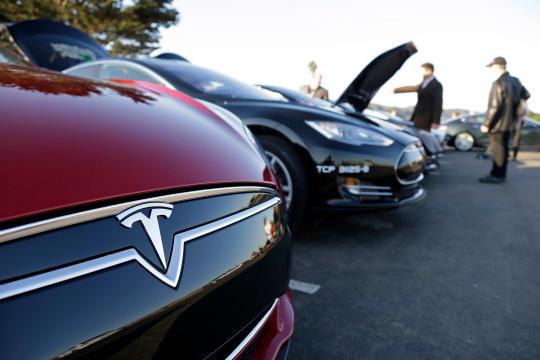
Just as it relies on its own stores and the Internet to sell its cars new, Tesla Motors has jumped into the used-car business on its own as well, opening an online store last week offering “pre-owned” Model S sedans in 11 cities — and, for some shoppers, potentially a good deal.
The Tesla site launched quietly last week looks less like a car dealer’s inventory and more like the Apple store’s remanufactured section. Buying the car requires a $1,000 deposit, and shoppers who aren’t located in the 11 cities around the country can get a vehicle shipped for an additional $1,500. Unfortunately for online tire-kickers accustomed to pouring over photos for flaws, Tesla doesn’t picture the actual model, but a generic representation.
The company says each used Model S it sells comes with a four-year or 50,000-mile warranty — although most are so new they would still be covered by the original owner’s 8-year, unlimited-mile warranty if sold privately with a $100 transfer fee.
And how do the prices stack up? At first glance, not too shabbily. The least expensive Model S in inventory sits in Atlanta, a 60-kWh 2013 edition with 10,481 miles and a $61,000 price tag. A check of that model and others shows prices that straddle those offered by private sellers and dealers, with a slight bias toward undercutting. By selling its own used cars, Tesla will bring some structure to a market that’s been all over the map and give some support to its resale values — even if it never has to buy a single giant inflatable gorilla.
The Galaxy S6 is finally out. You know you want it. It’s fast, slick, beautiful, and sexy. Yes, really. I want one. Maybe you do, too.
Under normal circumstances, I’d never be able to justify another cell phone purchase. But for a limited time, new and existing Sprint customers can lease a Galaxy S6 for free by committing to the Sprint Unlimited Plus plan. That plan is $80 a month and it comes with the 32GB Galaxy S6 through a crazy (good crazy, not crazy crazy) scheme where you get a $20 credit on the plan, which is the same price as leasing the phone, so the end result is that you pay nothing for the phone. (Or you can upgrade: For $5 more a month you can get the 64GB Galaxy S6; for $10 more a month get the 128GB Galaxy S6.)
The catch? You have to stay on that plan for 24 months. The plan itself is not too shabby though: Unlimited talk, text and data, International Value Roaming (in Telefonica countries), and annualphone upgrades. That’s right. You can hand back the Galaxy S6 when you start craving something else in a year.
iPad Air Rollback at Walmart
Been coveting a new iPad Air? Of course you are. Well then, get thyself to Walmart. Starting today, there is a very sweet iPad Air Rollback going on: The iPad Air 16 GB is dropped to $349 (originally $397) and the iPad Air 32 GB is $399 (originally $449). The newest model, the iPad Air 2, costs more.
Moto 360 Smart Watch
Are you an Android user experiencing Apple Watch Envy? Why not console yourself by splurging on the Moto 360 for $179? It looks good enough, works with your phone, and is – right now – $70 off. You can glance at your wrist instead of pulling out your phone to stay connected to your world. And here’s a suggestion: Every time someone tells you they are waiting for their $500 Apple Watch, glance at your wrist and ask how long they’ll have to wait. And then buy them a drink with the money you saved.
Jamstick
Those guitar lessons have given you more joy than you ever expected them too, right? Except when you are riding the train, flying, or in the back seat of your BFF’s subcompact. Well, if you have a Jamstick, you can rock out anywhere. It’s only 16 inches long. This iOS accessory is the neck part of the guitar, with real strings and frets. Connect it to your iOS device and it translates your finger action for music apps. But it’s way more than a portable practice guitar. It’s also a MIDI controller. So it can be any instrument you want, working with MIDI apps in the App Store. So, play your guitar, but be the entire band. Right now you can get $50 off its $299 price tag, making it $249, at Jamstick.com orApple.com.
Divoom Voombox-Outdoor
Do your weekend plans call for the great outdoors? Those plans need a soundtrack! And this rugged outdoor speaker can turn a patch of sand and a cheap blanket into a party. Divoom’s Voombox-Outdoor is $79.99, 20 percent off on its standard $100 price, on Amazon – right now.
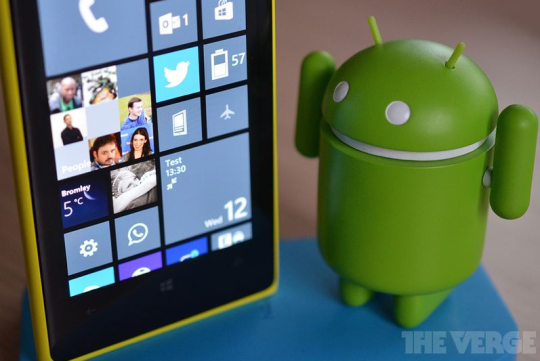
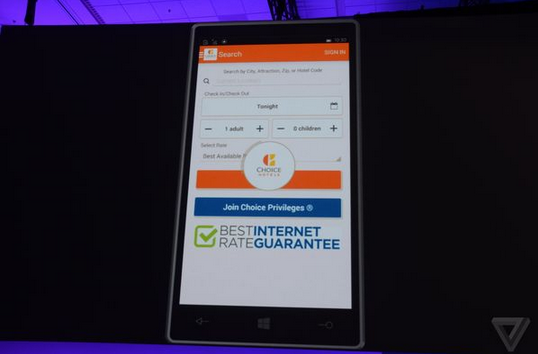
After months of rumors, Microsoft is revealing its plans to get mobile apps on Windows 10 today. While the company has been investigating emulating Android apps, it has settled on a different solution, or set of solutions, that will allow developers to bring their existing code to Windows 10.
iOS and Android developers will be able to port their apps and games directly to Windows universal apps, and Microsoft is enabling this with two new software development kits. On the Android side, Microsoft is enabling developers to use Java and C++ code on Windows 10, and for iOS developers they’ll be able to take advantage of their existing Objective C code. “We want to enable developers to leverage their current code and current skills to start building those Windows applications in the Store, and to be able to extend those applications,” explained Microsoft’s Terry Myerson during an interview with The Verge this morning.
The idea is simple, get apps on Windows 10 without the need for developers to rebuild them fully for Windows. While it sounds simple, the actual process will be a little more complicated than just pushing a few buttons to recompile apps. “Initially it will be analogous to what Amazon offers,” notes Myerson, referring to the Android work Microsoft is doing. “If they’re using some Google API… we have created Microsoft replacements for those APIs.” Microsoft’s pitch to developers is to bring their code across without many changes, and then eventually leverage the capabilities of Windows like Cortana, Xbox Live, Holograms, Live Tiles, and more. Microsoft has been testing its new tools with some key developers like King, the maker of Candy Crush Saga, to get games ported across to Windows. Candy Crush Saga as it exists today on Windows Phone has been converted from iOS code using Microsoft’s tools without many modifications.
During Microsoft’s planning for bringing iOS and Android apps to Windows, Myerson admits it wasn’t always an obvious choice to have both. “At times we’ve thought, let’s just do iOS,” Myerson explains. “But when we think of Windows we really think of everyone on the planet. There’s countries where iOS devices aren’t available.” Supporting both Android and iOS developers allows Microsoft to capture everyone who is developing for mobile platforms right now, even if most companies still continue to target iOS first and port their apps to Android at the same time or shortly afterward. By supporting iOS developers, Microsoft wants to be third in line for these ported apps, and that’s a better situation than it faces today.
Alongside the iOS and Android SDKs, Microsoft is also revealing ways for websites and Windows desktop apps to make their way over to Windows universal apps. Microsoft has created a way for websites to run inside a Windows universal app, and use system services like notifications and in-app purchases. This should allow website owners to easily create web apps without much effort, and list those apps in the Windows Store. It’s not the best alternative to a native app for a lot of scenarios, but for simple websites it offers up a new way to create an app without its developers having to learn new code languages. Microsoft is also looking toward existing Windows desktop app developers with Windows 10. Developers will be able to leverage their .NET and Win32 work and bring this to Windows universal apps. “Sixteen million .NET and Win32 apps are still being used every month on Windows 7 and Windows 8,” explains Myerson, so it’s clear Microsoft needs to get these into Windows 10.
Microsoft is using some of its HyperV work to virtualize these existing desktop apps on Windows 10. Adobe is one particular test case where Microsoft has been working closely with the firm to package its apps ready for Windows 10. Adobe Photoshop Elements is coming to the Windows Store as a universal app, using this virtualization technology. Performance is key for many desktop apps, so it will be interesting to see if Microsoft has managed to maintain a fluid app experience with this virtualization.
Collectively, Microsoft is referring to these four new SDKs as bridges or ramps to get developers interested in Windows 10. It’s a key moment for the company to really win back developers and prove that Windows is still relevant in a world that continues to be dominated by Android and iOS. The aim, as Myerson puts it, is to get Windows 10 on 1 billion devices within the next two to three years. That’s a big goal, and the company will need the support of developers and apps to help it get there.
These SDKs will generate questions among Microsoft’s core development community, especially those who invested heavily in the company’s Metro-style design and the unique features of Windows apps in the past. The end result for consumers is, hopefully, more apps, but for developers it’s a question of whether to simply port their existing iOS and Android work across and leave it at that, or extend those apps to use Windows features or even some design elements. “We want to structure the platform so it’s not an all or nothing,” says Myerson. “If you use everything together it’s beautiful, but that’s not required to get started.”
Microsoft still has the tricky mix of ported apps to contend with, and that could result in an app store similar to Amazon’s, or even one where developers still aren’t interested in porting. This is just the beginning, and Windows universal apps, while promising, still face a rocky and uncertain future.
LG has just unveiled its G4 smartphone, and based on our short time with the handset, it might be one of the best phones you can buy when it hits the market this June.
The G4 improves on its predecessor, the LG G3, in a number of ways, and, most importantly to LG, rivals Apple’s iPhone 6 and Samsung’s Galaxy S6 in terms of features and performance.
Real leather
The most interesting thing about the G4 is its design. LG wants its new phone to be one of the best-looking smartphones on the planet, and to do that, it is offering the G4 with a rear panel covered in high-quality leather.
This isn’t the plastic faux leather you’ll find on Samsung’s Galaxy Note 4, either. LG says it spent three years researching how to produce the leather for the G4 and that the process to make one panel takes three months.
The company also used a special treatment process to ensure that the leather is more resistant to scratches and abrasions as well as water stains.
A pair of stitches run down the center of the G4’s back panel, giving the phone the look of a high-end handbag. I did notice, however, that the stitching felt a bit rough when you run your finger down it. That said, I didn’t notice it when holding the phone normally.
If leather isn’t your thing, you can opt for a G4 with a plastic back panel. And if you do buy a leather back and get tired of it, you can always swap it out for a different panel.
Like its predecessors the LG G2 and LG G3, the G4 has its power and volume buttons on its back panel rather than on its side. LG says this makes the buttons easier to reach, though I’ve found that it takes some getting used to and can be confusing for first-time owners.
Camera improvements
LG is also hyping the G4’s new 16-megapixel rear camera, which it says can capture better photos than Apple’s iPhone 6 and Samsung’s Galaxy S6. The camera packs a 1.8 aperture lens that the company claims will be able to take brighter images in low-light settings than the iPhone 6 and the S6.
And with its improved optical image stabilization (OIS), which physically moves the camera’s lens to compensate for hand shaking, LG says the camera will be able to take more detailed photos no matter where you’re shooting.
According to LG, the G4’s OIS is better than the OIS used on the Galaxy S6 because it can move along three axes. Samsung’s camera can move along just two axes. The iPhone 6 doesn’t used OIS, instead relying on digital image stabilization. The iPhone 6 Plus, however, does have OIS.
The G4 also packs a color spectrum sensor, which LG says helps the camera capture colors that are more true to life than those captured by other smartphone cameras.
During my testing, I found the Galaxy S6’s camera to be better than the iPhone 6’s. So if the G4 can beat that, it might be the best smartphone camera around.
Quantum mechanics display
In addition to its design and camera, LG is seriously pushing the G4’s new 5.5-inch, 2560x1440 resolution display. According to the company, the display uses a new technology based on quantum mechanics that makes the screen produce more vivid colors.
The display is also the first smartphone screen to be certified compliant with Hollywood’s Digital Cinema Initiative (DCI), which means colors in movies should look the same on the G4 as they do on the big screen. How that impacts colors seen on websites, photos, and games remains to be seen.
To demonstrate how the G4’s display compares to the Galaxy S6’s and the iPhone 6 Plus’s, LG showed us the same image of a bushel of strawberries on each screen. True to the company’s word, the G4’s screen offered deeper reds and more vibrant greens than either the S6 or iPhone 6 Plus. Still the G4’s screen was a bit dim compared to those of the S6 and the iPhone 6.
That said, the image was a test photo selected by LG, so we’ll have to see how the screens compare with our own images.
Interface and performance
Inside, the G4 runs on Google’s Android 5.0 Lollipop. LG chose to keep the operating system’s look mostly stock rather than altering it too much like other smartphone makers, which is always welcome.
In terms of performance, the G4 runs on a quad-core processor, 3 GB of RAM, and 32 GB of storage. There’s also a microSD card slot that lets you increase storage capacity and a removable battery — both things that Samsung dropped from the Galaxy S6, much to the chagrin of more hardcore smartphone fans.
From the look of it, the LG G4 could have what it takes to be one of the best smartphones on the planet, especially if its camera and display live up to the hype.
LG has remained mum on pricing for the G4, but we expect it to cost $199 with a two-year contract. Availability is set for the end of May or the beginning of June, though the company hasn’t quite nailed down the date yet.
Insiders who signed up for the Windows 10 Technical Preview beta program should know there’s a new release in town, build version 10061. The new Windows 10 version brings several additional features, including brand new apps for mail and calendar, as well as more user interface tweaks.
The new Outlook Mail app brings new customizable Swipe Gestures,Microsoft revealed in a blog post, similar to what you’d expect from a mobile version of the app, letting users set up for left and right swipes, including deleting, flagging, moving or marking an email as read or unread. The new mail app, but also Calendar, also come with support for Office 365, Exchange, Outlook.com, Gmail, IMAP, POP and other accounts.
Furthermore, Outlook “leverage the familiar and rich capability of Word,” allowing you to insert tables, pictures and more complex formatting to emails.
The company says both Outlook and Calendar bring improved performance and a new three-pane email UI that lets users quickly switch between email and calendar with a toggle.
Microsoft says it also tweaked Start, Taskbar and Action Center. A new black system theme is available across Start, Taskbar and Action Center. Furthermore, the Start menu can be resized, and has transparency, just like Taskbar. Users can also customize the Start menu by applying the primary color of their desktop backgrounds.
The company says it has also improved its Continuum experience – or switching from PC to tablet mode – by applying obvious visual changes that make it easier for users to interact with the UI once the move to tablet mode is performed. The Start, Cortana and Task View buttons grow in size in tablet mode, and items in the Notifications also get bigger to improve touch actions.
Windows 10 build 10061 also brings an improved Virtual Desktops experience, allowing users to create as many virtual desktops as they desire. More details about the new Windows beta version, including known bugs and issues that have been fixed in this release, are available at the source link.
An Apple Watch could be in your hand – or, rather, on your wrist – sooner than anticipated.
The Apple Watch could come your way sooner than you think. (Apple)
Apple has consistently been telling buyers of its new smartwatch, which officially launches Friday, that they may need to wait to receive their device. But the company has ever-so-slightly changed its tune.
According to a statement that Apple sent to CNET on Thursday:
We’re happy to be updating many customers today with the news that their Apple Watch will arrive sooner than expected. Our team is working to fill orders as quickly as possible based on the available supply and the order in which they were received. We know many customers are still facing long lead times and we appreciate their patience.
Several readers of 9to5Mac say their order status has changed from “processing” to “preparing for shipment.” Some customers are also starting to see credit-card charges for their Apple Watch orders, which would only happen if the devices were ready to ship.
Some may receive them as soon as Friday, according to MacRumors. A notice sent to some customers who preordered indicates an arrival that day.
At its retail stores, the company requires you to make a reservation to order the watch, which then arrives at some point at the store or at your home. Apple has also been urging people to order the wearable over the Internet through the online Apple Store or the Apple Store app. The wait times listed online for most of the models now show aJune time frame for delivery.
But what if you haven’t preordered the Apple Watch and are now eager to get one? Apple has stated that the device won’t be available for immediate purchase at its Apple Stores. But an Apple Store isn’t your only option. The watch is also being sold at boutiques and fashion outlets. And you might just be able to walk out with an Apple Watch from one of these retailers.
But whether you can walk out of one of those stores with the smartwatch on your wrist depends on which model you choose. The Apple Watch, the company’s long-awaited entrant in the market for smart wearables, comes in three versions: the entry-level Sport version that starts at $349, the midlevel Apple Watch starting at $549 and the Apple Watch Edition with a starting price of $10,000.
Adrian Joffe, chief executive of Dover Street Market, told the Times that his company would have around 350 Apple Watches in its Ginza store and 570 in its London store. But those of you willing to shell out the money for the gold Edition are out of luck – that version is currently on backorder at Dover Street Market.







 The Apple Watch could come your way sooner than you think. (Apple)