The Ford GT. I’ll drive this car any day. (Photo: Rafe Needleman/Yahoo)
Mark Fields, the new CEO of Ford, paid a visit the the nerd journalist corps last week. He visited Ford’s Research and Innovation Center in Palo Alto, California. While his people were showing off the new Ford GT (quick review: holy wow) and weird plastic springs the company will be using soon to save weight in its cars, I got a chance to spend a few minutes with him one-on-one.
From my perspective, one interesting threat to the status quo of car companies is autonomous vehicles. Self-driving technologies could re-write the car business.
Fields, of course, says he sees new technology as an opportunity.
For people who want self-driving cars, Ford will eventually offer them. For those that like to drive, that’ll stay an option. “We will offer a full line of autonomy levels,” he told me. He emphasized that, at least in our lifetimes, Ford cars will always offer their owners the capability to drive. If they want it.
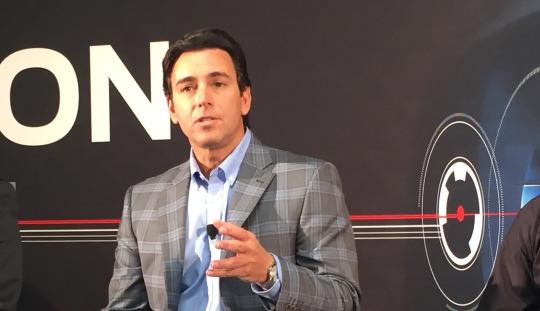
Ford CEO Mark Fields at the Ford Research and Innovation Center in Palo Alto, CA. (Photo: Rafe Needleman/Yahoo Tech)
“We don’t see a disconnect,” he said. “We don’t see driving and autonomy as exclusive.” He said Ford will continue to work on making cars that are “both fun to drive and fun to ride,” and that “there will always be a spectrum of autonomy, in our lifetime.” (To calibrate that statement: Fields is 54.)
However, during an earlier presentation at the Research Center that day, Ford execs discussed the challenges of building cars that are safe to drive in spite of the advancements in self-driving technology. The problem isn’t just that technology can distract drivers from operating their cars safely. There’s also the reverse problem: If cars are too autonomous and thus too boring to pay attention to while they are driving, the human “driver” might not be paying attention when he or she needs to take over.
For this reason, Google has proposed taken the driver out of the loop completely its prototype self-driving pod cars. There’s a big red emergency stop button, but no steering wheel or pedals. There’s no way the driver/passenger can make a bad decision and screw things up, and the car’s programmers don’t have to account for unpredictable humans trying to take control.
Fields also sees electric propulsion gathering steam, as it were. While he wouldn’t predict when (or if) electric cars will become mainstream, he did say that Ford will continue to offer more options. “Our approach is to offer choice,” he said.
The Uberization
Another fundamental threat to the future of the car business is the changing nature of car ownership. Fields sees this. “A certain population wants access more than ownership,” he said. And Ford, ultimately, is not a car company per se. “We’re a mobility company.“
Ford is running 25 experiments around the globe, he said, working on things like “usership” instead of ownership, and using social collaboration tools to help people find cars to get them where they are going. “We are trying to solve big societal issues,” he said.
(One cool technology Ford is working on, that sounds like a Silicon Valley fantasy: The ability for cars to recognize open parking spaces they pass by, and then transmit this data to a service that tells other cars, whose drivers are looking for spots, where one is near them.)
Too much tech?
My big fear, when it comes to automotive technology, especially from a company that’s newly trying to re-cast itself as a service company, is that its services will know a bit too much about their customers: Where they are, who they may be with, and what they are doing in their mobility devices.
Fields didn’t quite have an answer for this, but he did have a line at the ready. “We are committed to being trusted stewards of customer data,” he told me. “We have to ask the customer whether they want to opt it.”
He told me the customer has to see a benefit of sharing data. For example, a car that knows it needs an oil change could help its owner schedule the service.
But what about insurance companies who give you better rates when you opt in? Won’t they eventually make keeping your driving data private unaffordable? Or over-eager courts, or police, who absorb data under arguably legal, but questionable pretense?
Just as it is for online companies and mobile phone companies, stewarding customer data is tricky. Especially when customers seem to be so eager to expose so much data in return for, usually, incremental value.
Call it usership or ownership or whatever you like, but technology is changing our relationship with nearly every facet of mobility. Ford may indeed remain a “Big 3″ auto maker for the foreseeable future. But it’s also possible that technology will drive new companies to prominence, just as it has for nearly every other industry on the planet.
Did you hear the one about how Apple Watch apps from third-party developers aren’t allowed to tell the time?
No, really. It’s an actual rule from Apple listed under section 10 of the company’s “App Store Review Guidelines”. It reads: “Watch Apps whose primary function is telling time will be rejected.”
The Apple Watch represents an unprecedented leap forward by Apple in many ways, but the workings of its app store isn’t one of them. As it’s done with the iPhone and the iPad, Apple has specific ideas about what third-party apps can and cannot do.
Color Inside the Lines
Apple’s guidelines outlining its App Store rules, in which the phrase “will be rejected” appears 103 times, should make one thing clear: The Apple Watch platform isn’t really all that open.
And Apple doesn’t just want to ban apps that crash, violate users’ privacy or threaten their security. It also uses its rules to class up the joint.
As a line from the intro to the review guidelines states: “If your App doesn’t do something useful, unique or provide some form of lasting entertainment, or if your app is plain creepy, it may not be accepted.”
The problem this creates for Apple—beyond the inherent difficulty of repealing Sturgeon’s Law, the principle that “90 percent of everything is crap”—is that subjective rules enforced by busy people rarely make for consistent enforcement. Or happy developers.
Meanwhile, outside developers whose apps may compete with Apple’s present or potential products can only guess if an App Store rejection was motivated by self-interest.
For instance, when Apple rejected an update to a navigation app that had mentioned support for Pebble’s smartwatches, was that the reason? An Apple rep told Wired no, the rejection was a mistake.
But banning watch-face apps? It could be read as an attempt by Apple to prevent a flood of crummy-looking watch faces, or to outright halt the development of apps that duplicate a core Watch feature (telling time). Or perhaps the company reserving the watch-face market for itself and, later on, some specially-picked partners.
Apple Has Actually Made This Work
There are many reasons to dislike Apple’s we-know-what’s-best approach to mobile apps, and I’ve expressed most of them at one time or another.
Meanwhile, the more important fact about the App Store, relative to Google Play, remains its demonstrated ability to make more money for developers. The market-research shop App Annie reported that in the first quarter of this year, the App Store’s worldwide revenue was 70 percent higher than Play’s—even though Google’s app market had 70 percent more downloads than Apple’s.
Google seems to have taken note that overall app quality affects revenues, and it announced in March that several months earlier, ithad begun reviewing Android apps for violations of its own app rulesbefore posting them on Google Play. But it says its reviewers deliver judgment in hours, not “days or weeks.”
Apple Could Do Better
If you don’t like the way Apple runs its App Store, it’s not like there’s an easy workaround. While Google allows users to download Android apps from sources it doesn’t run, Apple does not. (At least not for consumers: Developers can enroll small numbers of users in test apps that bypass the Store,)
But Apple could and should make the App Store work better for its users and its developers. The App Store makes it unnecessarily hard to see if a developer has done a good job in general. To see what other apps a developer has shipped requires an extra tap or click, and then you need to bring up each title’s entry to see its user rating.
Apple would also ease a lot of concerns about favoring its own apps if it would let users choose third-party replacements as their defaults. We can do that with third-party keyboards now; why not let an alternative mapping app, e-mail client. or Web browser replace the device’s defaults?
Which brings us back to the Apple Watch: Yes, Apple, your watch faces are beautiful. So why not let your customers take this, the most personal of your devices ever, and personalize it even more.
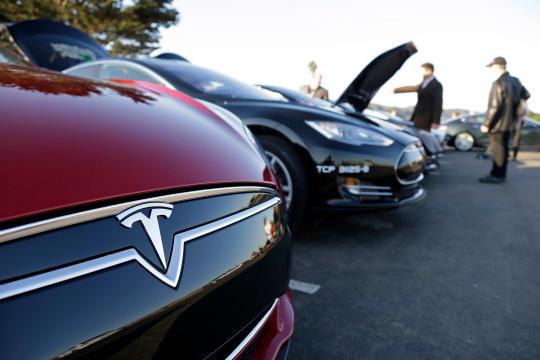
Just as it relies on its own stores and the Internet to sell its cars new, Tesla Motors has jumped into the used-car business on its own as well, opening an online store last week offering “pre-owned” Model S sedans in 11 cities — and, for some shoppers, potentially a good deal.
The Tesla site launched quietly last week looks less like a car dealer’s inventory and more like the Apple store’s remanufactured section. Buying the car requires a $1,000 deposit, and shoppers who aren’t located in the 11 cities around the country can get a vehicle shipped for an additional $1,500. Unfortunately for online tire-kickers accustomed to pouring over photos for flaws, Tesla doesn’t picture the actual model, but a generic representation.
The company says each used Model S it sells comes with a four-year or 50,000-mile warranty — although most are so new they would still be covered by the original owner’s 8-year, unlimited-mile warranty if sold privately with a $100 transfer fee.
And how do the prices stack up? At first glance, not too shabbily. The least expensive Model S in inventory sits in Atlanta, a 60-kWh 2013 edition with 10,481 miles and a $61,000 price tag. A check of that model and others shows prices that straddle those offered by private sellers and dealers, with a slight bias toward undercutting. By selling its own used cars, Tesla will bring some structure to a market that’s been all over the map and give some support to its resale values — even if it never has to buy a single giant inflatable gorilla.
The Galaxy S6 is finally out. You know you want it. It’s fast, slick, beautiful, and sexy. Yes, really. I want one. Maybe you do, too.
Under normal circumstances, I’d never be able to justify another cell phone purchase. But for a limited time, new and existing Sprint customers can lease a Galaxy S6 for free by committing to the Sprint Unlimited Plus plan. That plan is $80 a month and it comes with the 32GB Galaxy S6 through a crazy (good crazy, not crazy crazy) scheme where you get a $20 credit on the plan, which is the same price as leasing the phone, so the end result is that you pay nothing for the phone. (Or you can upgrade: For $5 more a month you can get the 64GB Galaxy S6; for $10 more a month get the 128GB Galaxy S6.)
The catch? You have to stay on that plan for 24 months. The plan itself is not too shabby though: Unlimited talk, text and data, International Value Roaming (in Telefonica countries), and annualphone upgrades. That’s right. You can hand back the Galaxy S6 when you start craving something else in a year.
iPad Air Rollback at Walmart
Been coveting a new iPad Air? Of course you are. Well then, get thyself to Walmart. Starting today, there is a very sweet iPad Air Rollback going on: The iPad Air 16 GB is dropped to $349 (originally $397) and the iPad Air 32 GB is $399 (originally $449). The newest model, the iPad Air 2, costs more.
Moto 360 Smart Watch
Are you an Android user experiencing Apple Watch Envy? Why not console yourself by splurging on the Moto 360 for $179? It looks good enough, works with your phone, and is – right now – $70 off. You can glance at your wrist instead of pulling out your phone to stay connected to your world. And here’s a suggestion: Every time someone tells you they are waiting for their $500 Apple Watch, glance at your wrist and ask how long they’ll have to wait. And then buy them a drink with the money you saved.
Jamstick
Those guitar lessons have given you more joy than you ever expected them too, right? Except when you are riding the train, flying, or in the back seat of your BFF’s subcompact. Well, if you have a Jamstick, you can rock out anywhere. It’s only 16 inches long. This iOS accessory is the neck part of the guitar, with real strings and frets. Connect it to your iOS device and it translates your finger action for music apps. But it’s way more than a portable practice guitar. It’s also a MIDI controller. So it can be any instrument you want, working with MIDI apps in the App Store. So, play your guitar, but be the entire band. Right now you can get $50 off its $299 price tag, making it $249, at Jamstick.com orApple.com.
Divoom Voombox-Outdoor
Do your weekend plans call for the great outdoors? Those plans need a soundtrack! And this rugged outdoor speaker can turn a patch of sand and a cheap blanket into a party. Divoom’s Voombox-Outdoor is $79.99, 20 percent off on its standard $100 price, on Amazon – right now.